Mobile version coming soon
🧑💻 Oops, no mobile magic yet
🧑💻 Oops, no mobile magic yet
🧑💻 Oops, no mobile magic yet
This portfolio is best viewed on a larger screen—for now!
Between projects, parenting, and the daily rush, I haven’t had time to build the mobile version yet.
Thanks for your patience and for stopping by anyway!
I swear I’m working on it… right after I finish this project, feed the kid, answer 27 emails, and maybe sleep a bit.
Until then, try visiting from a bigger screen. It’ll be worth it—I promise!
I swear I’m working on it… right after I finish this project, feed the kid, answer 27 emails, and maybe sleep a bit.
Until then, try visiting from a bigger screen. It’ll be worth it—I promise!
Redesigning Fare Upselling for Binter:
From Hidden Option to Strategic Growth Driver
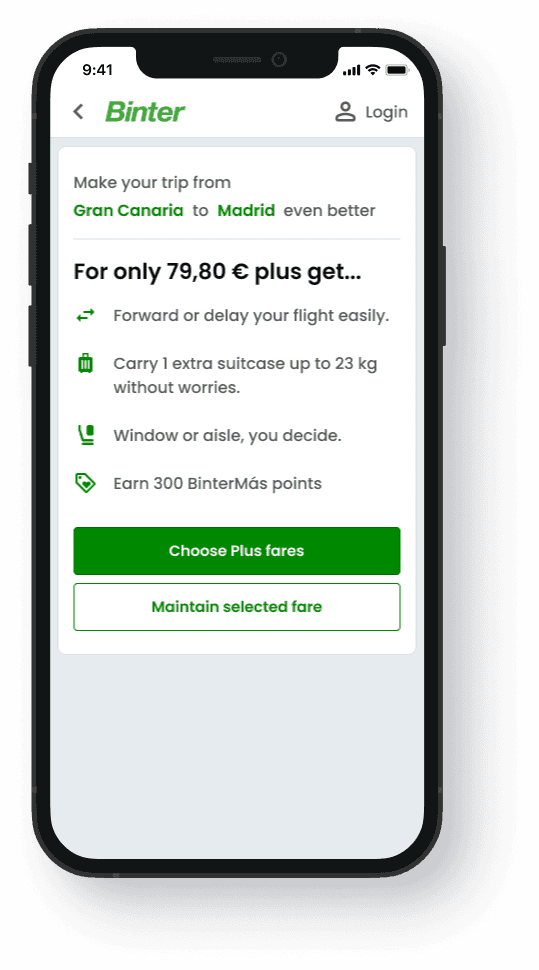
Upgrade from
Basic to Plus fare
Highlights added flexibility, baggage allowance, and seat choice for a more comfortable trip.
Upgrade from
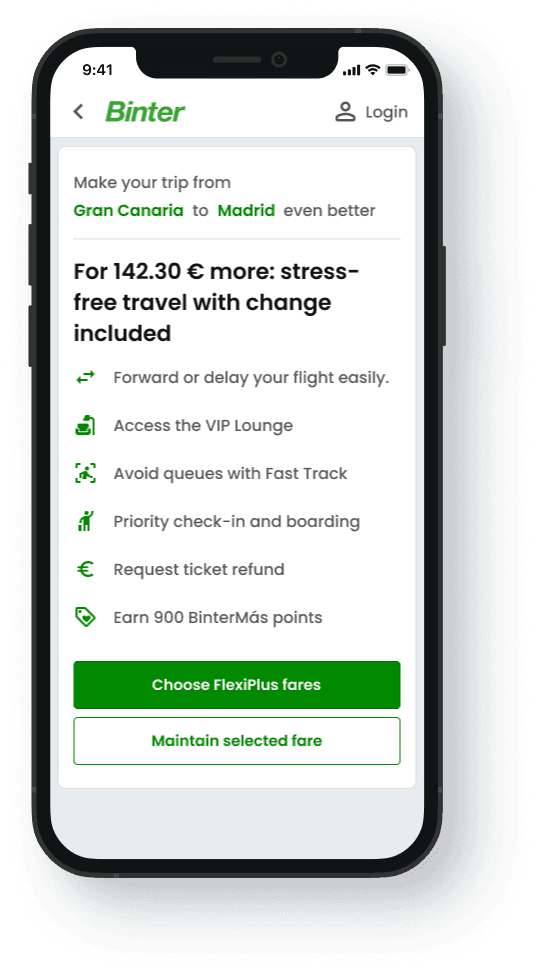
Plus to FlexiPlus fare
Promotes a smoother journey with fast track, VIP lounge access, and priority boarding.
Upgrade from
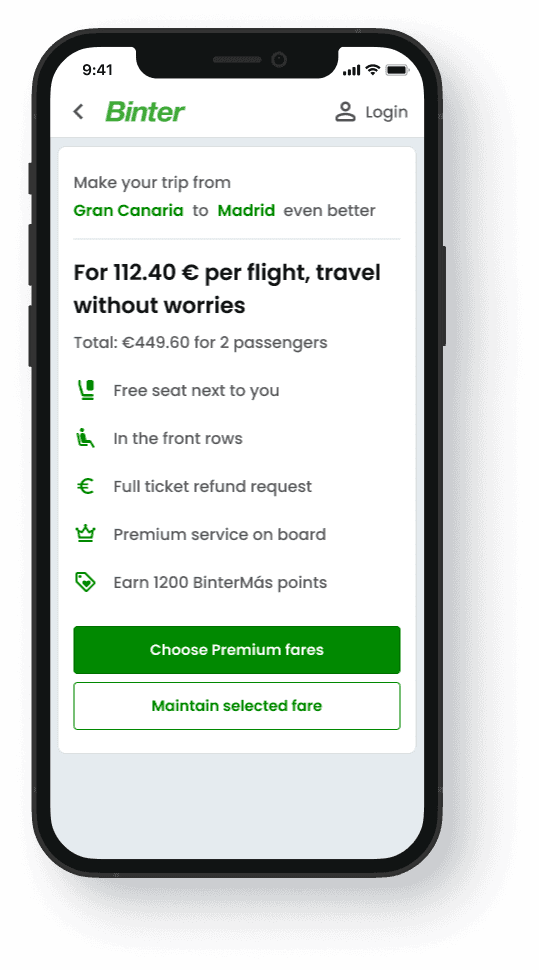
Plus to Premium fare
Offers a top-tier experience with premium seating, full refund, and exclusive onboard service.
Upgrade from
Basic to Plus fare
Highlights added flexibility, baggage allowance, and seat choice for a more comfortable trip.
Upgrade from
Plus to FlexiPlus fare
Promotes a smoother journey with fast track, VIP lounge access, and priority boarding.
Upgrade from
Plus to Premium fare
Offers a top-tier experience with premium seating, full refund, and exclusive onboard service.
Upgrade from
Basic to Plus fare
Highlights added flexibility, baggage allowance, and seat choice for a more comfortable trip.
Upgrade from
Plus to FlexiPlus fare
Promotes a smoother journey with fast track, VIP lounge access, and priority boarding.
Upgrade from
Plus to Premium fare
Offers a top-tier experience with premium seating, full refund, and exclusive onboard service.
Upgrade from
Basic to Plus fare
Highlights added flexibility, baggage allowance, and seat choice for a more comfortable trip.
Upgrade from
Plus to FlexiPlus fare
Promotes a smoother journey with fast track, VIP lounge access, and priority boarding.
Upgrade from
Plus to Premium fare
Offers a top-tier experience with premium seating, full refund, and exclusive onboard service.
How a Behaviour-Driven Redesign Increased Fare Upsell Conversion and Improved Passenger Decision-Making
PROBLEM
Passengers struggled to understand fare differences, leading to low upsell conversion and slow, uncertain decisions during booking.
MY ROLE
Senior Product Designer. Led research, strategy, decision-model design, fare comparison redesign, and user validation.
SOLUTION
A behaviour-centric redesign that simplified the decision process with clearer value communication, transparent fare comparison, and reduced cognitive load.
IMPACT
The redesign lifted upgrade engagement to 12.71%, increased Plus and FlexiPlus upsells to 13.70% and 9.80%, and boosted high-fare revenue across key routes.
The Problem
Binter Canarias offered several fare levels (Basic, Plus and Flexi), but the existing upselling experience did not clearly communicate the differences, benefits or real value of each fare.
This led to:
Low upgrade conversion.
Uninformed or uncertain decisions.
An increase in support queries and complaints related to baggage and fare changes.
Visual and content inconsistencies across digital channels.
The company needed a clearer, more transparent, and business-aligned experience—one that empowered users rather than overwhelming them.
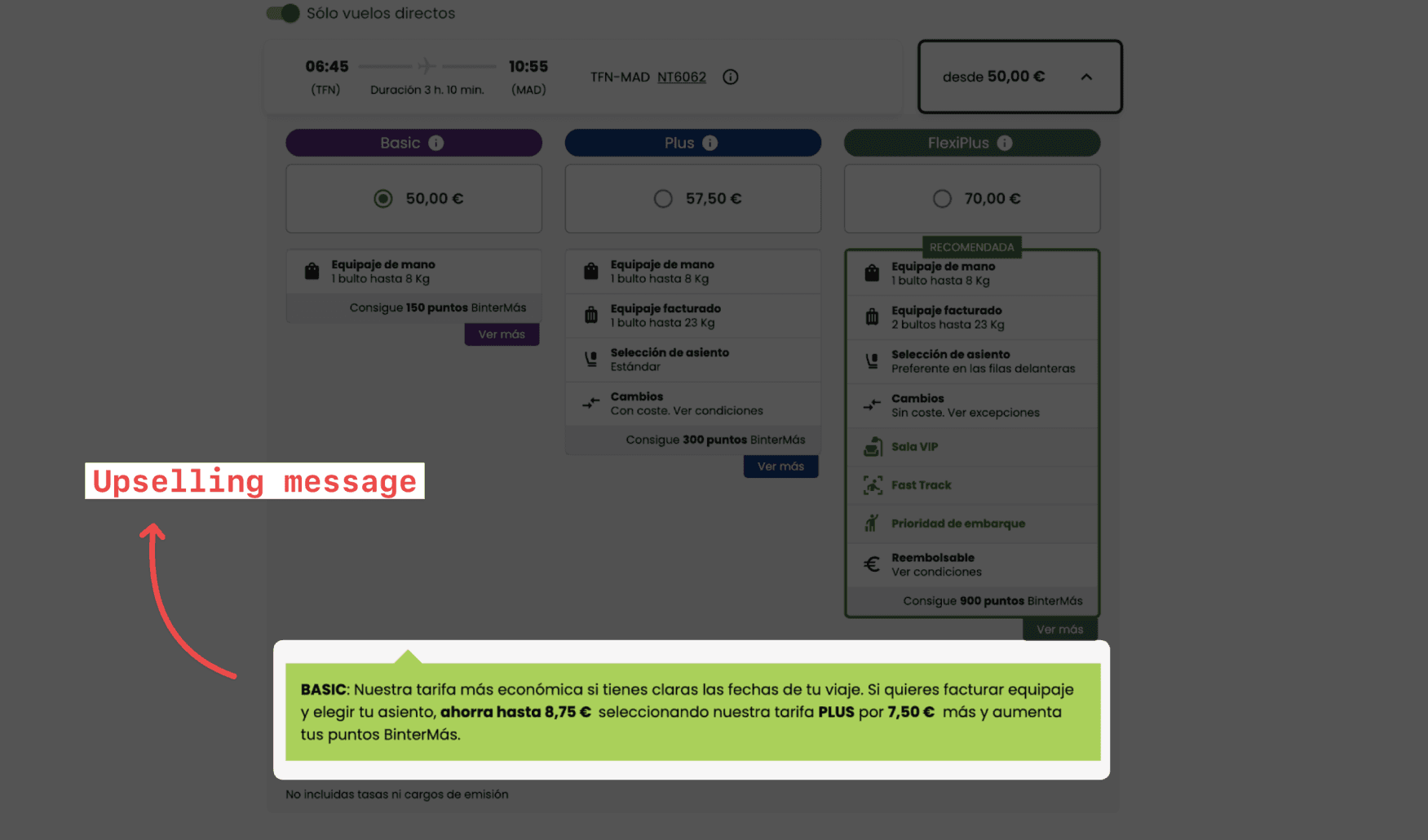
Screenshot of the initial upselling message implemented in the fare selection flow.
Scope and Business Value
What we redesigned
1
The full fare-selection flow across web and mobile.
3
The comparative layout using behaviour-design principles.
2
The benefits architecture and content, rewritten in plain language.
4
Visual and structural consistency across platforms.
Why it mattered
1
Increase revenue by improving upgrade conversion.
3
Strengthen users’ understanding of value and flexibility.
2
Reduce friction and support queries.
4
Align the experience with Binter’s commercial strategy.
Process
Phase 1
Research & Diagnosis
Our discovery phase combined qualitative and quantitative methods:
Heuristic evaluation: We identified low visual hierarchy, overly technical language, and weak differentiation between fare tiers.
Data analysis: Mobile users showed higher engagement but were not completing the upgrade—indicating friction in decision-making.
Benchmarking: We reviewed how Iberia, EasyJet, Ryanair, and LATAM use pricing anchors and persuasive patterns in fare selection.
Motivation mapping: We asked: what are users really looking for when considering an upgrade? Comfort? Flexibility? Peace of mind?
Key Insight
The product wasn’t the issue—the communication and timing were. Users weren’t clearly told why upgrading mattered to them.
Phase 2
Behaviour-Centered Ideation
Here, my role extended beyond UX into strategy facilitation. I reframed the fare upgrade as a three-part decision framework:
What do I have now?
What will I gain by upgrading?
Is the difference worth it for me?
To deepen our behavioural approach, we mapped out the user’s decision-making journey across key moments in the booking flow. We identified two critical decision thresholds:
Vital Moment 1: Selecting outbound and return flights.
Vital Moment 2: Considering fare upgrades before final confirmation.
We used a progressive disclosure strategy—limiting cognitive overload by delaying fare improvement options until the user had chosen their flights. This allowed us to frame the upgrade as a value-driven decision, not a distraction.
The following user flow diagram visualizes these moments, highlighting interactions, motivations, and core decisions:
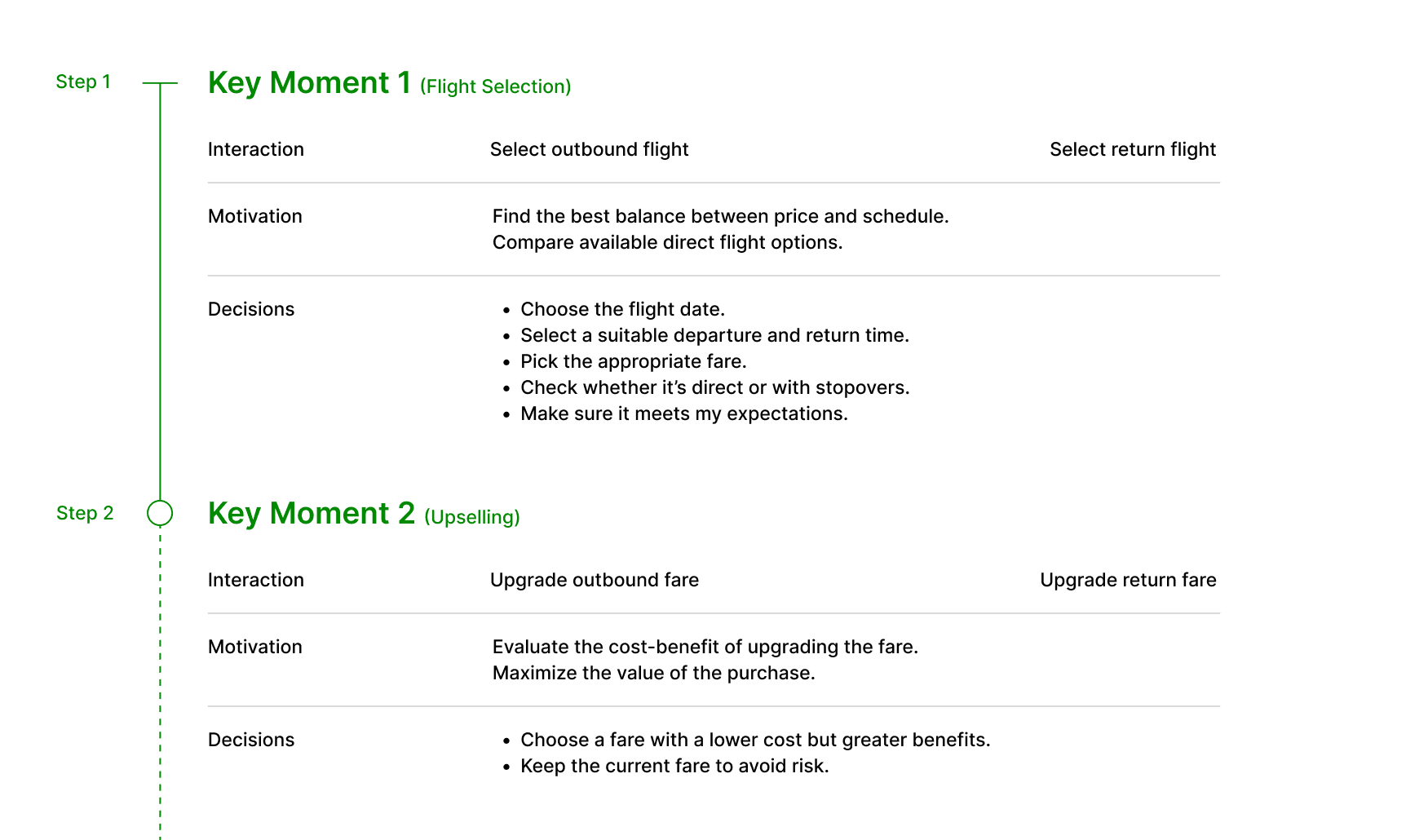
User journey highlighting two key moments: flight selection and fare upselling, with motivations and decision points.
Key design decisions:
Here, my role extended beyond UX into strategy facilitation. I reframed the fare upgrade as a three-part decision framework:
Vertical card layout with clear visual differentiation between current fare and upgrade options.
Price anchoring: We positioned higher fares first with minimal price difference to influence perception of value.
Emotional copywriting: We replaced technical feature lists with emotional prompts like “Travel worry-free” or “Bring what you need, without extra charges.”
Microinteractions: Especially in the app, we smoothed transitions between tiers to reduce cognitive load.
Personal Reflection
As a UX Lead, I had to advocate for storytelling in UX. Numbers alone won’t shift behavior—emotionally aligned design does.
Phase 3
Prototyping, Testing & Implementation
Design decisions driven by behavioral insights
The proposed design leveraged a thoughtful combination of cognitive heuristics and behavioral principles to drive conversion in a way that felt helpful, not intrusive. By focusing on perceived value, social proof, loss aversion, and choice architecture, our aim was to craft an experience where the user felt in control and confident in their decision—while being subtly influenced by psychologically grounded nudges.
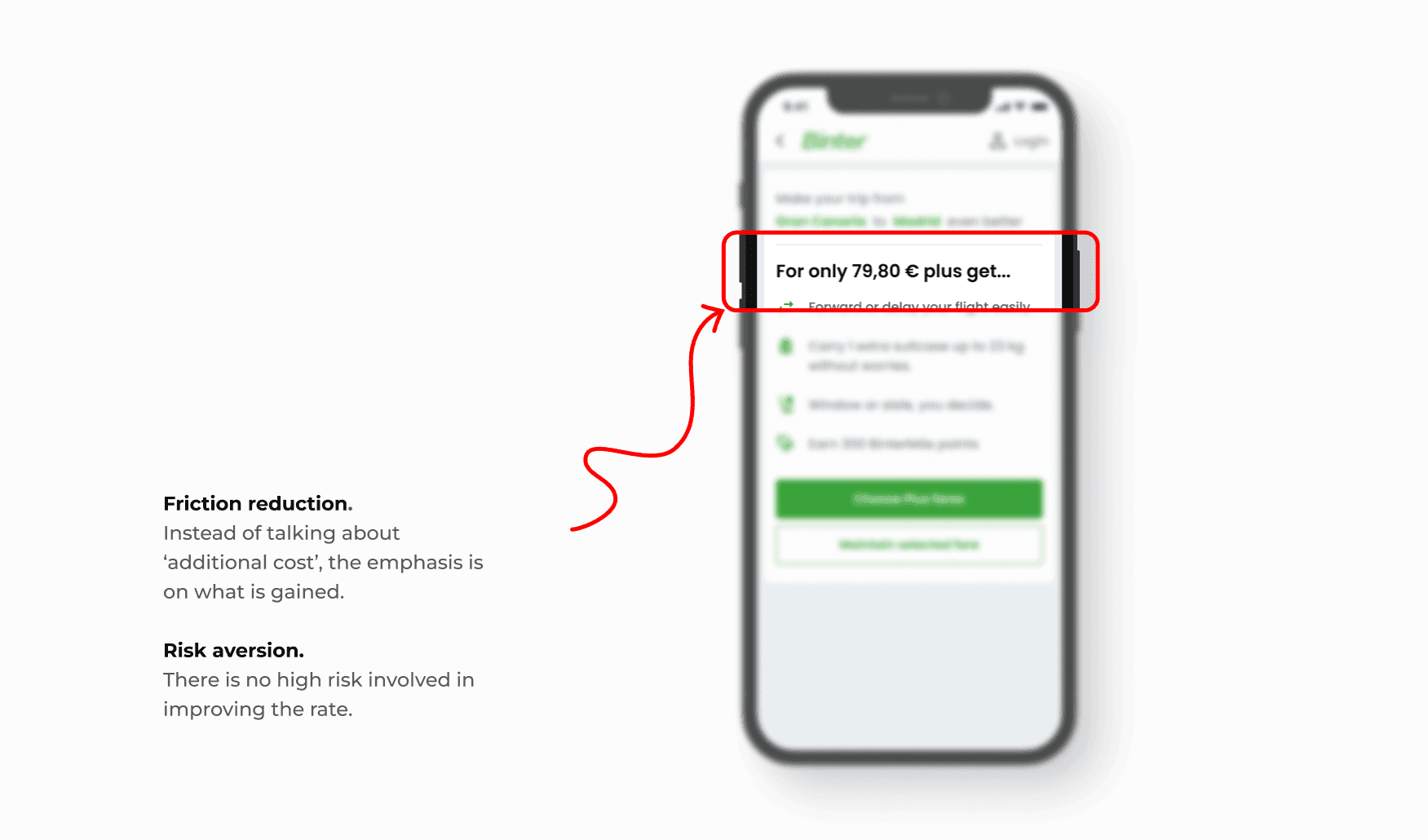
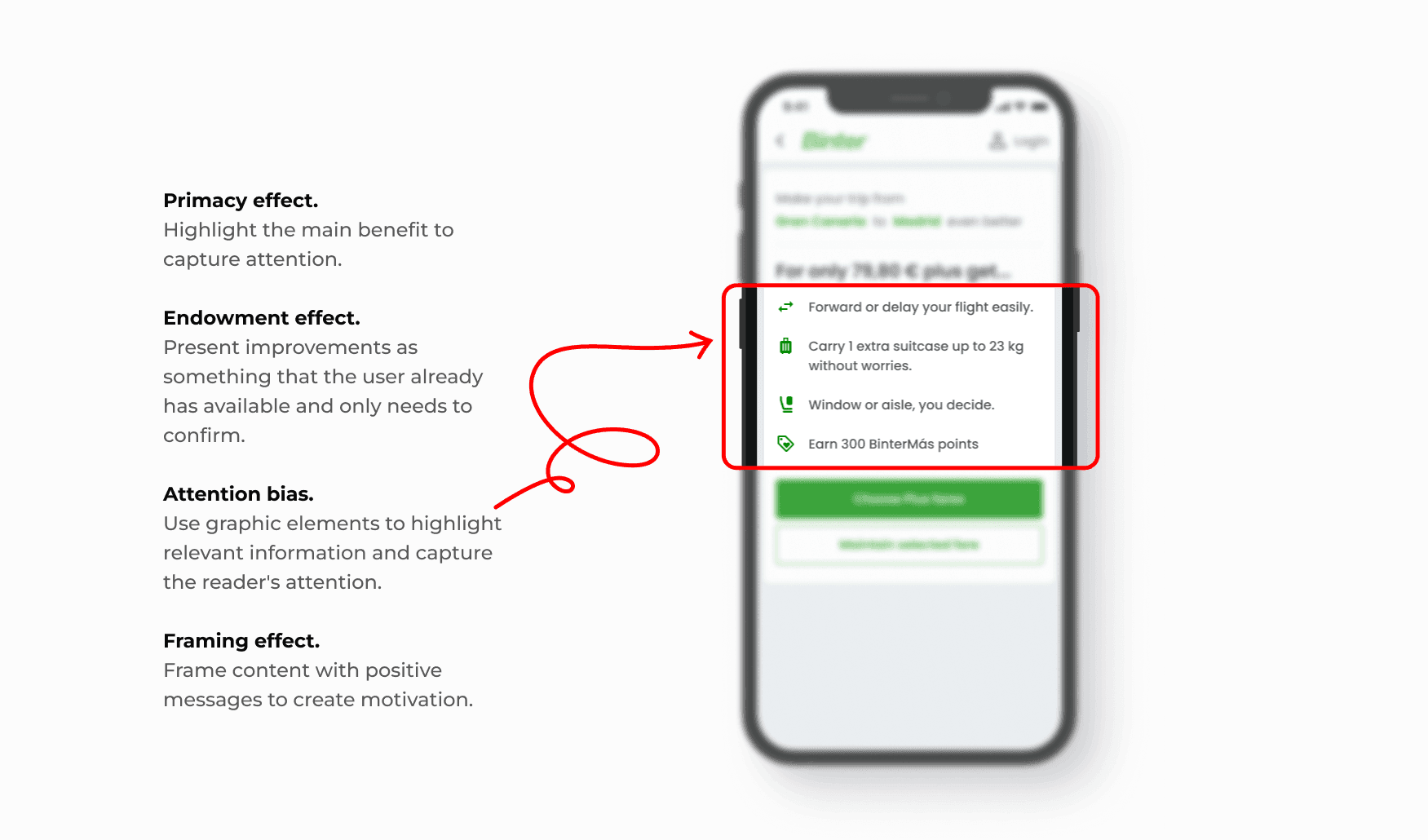
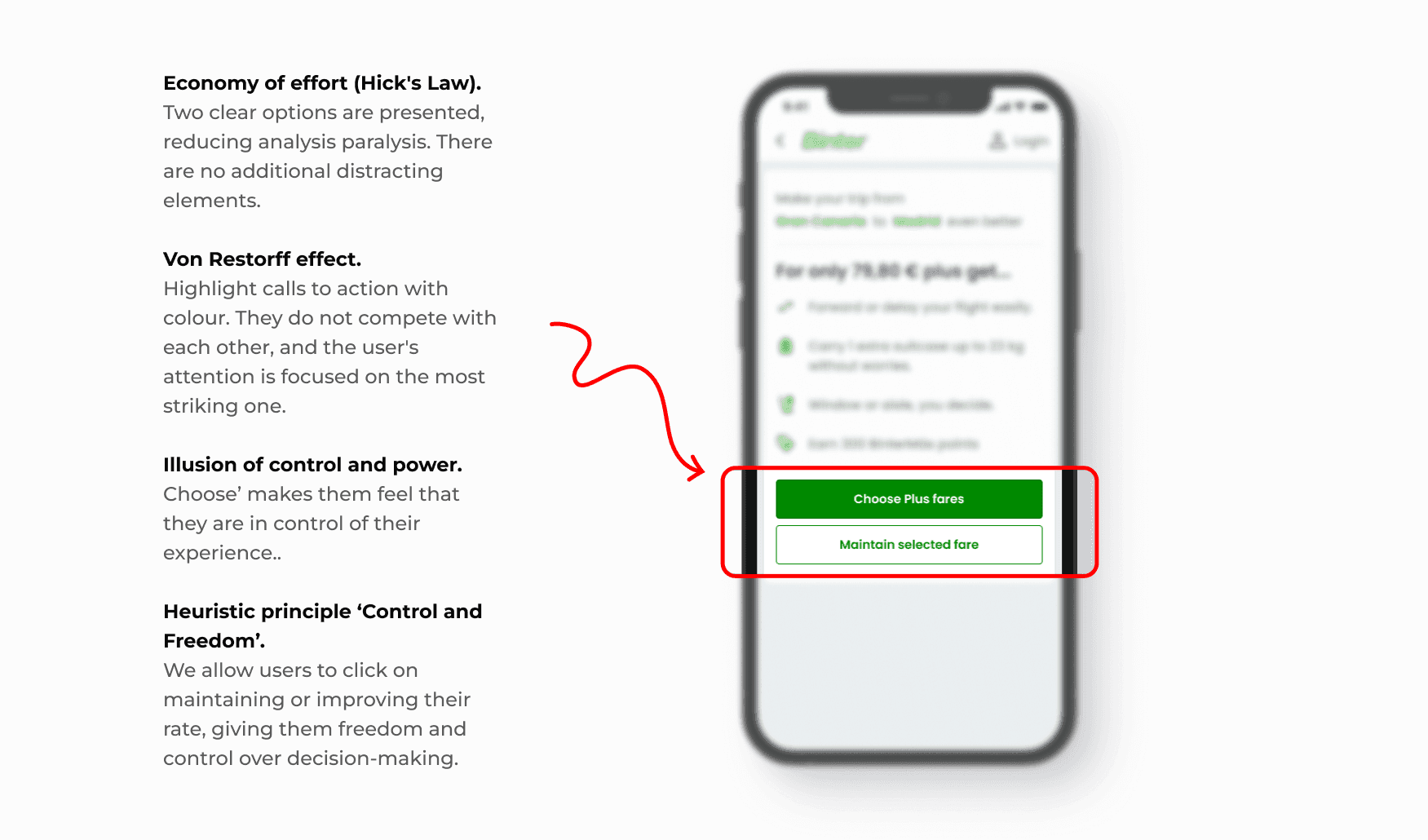
Scenario-Based Prototyping
We prototyped several visual and messaging variations based on distinct user scenarios:
When the outbound and return flights have different fare types
When both flights have the same fare type
When the reservation includes only one passenger
When the reservation includes multiple passengers
When the upsell price is under €100
When the upsell price is above €100
We also planned a technically feasible and reversible rollout roadmap in collaboration with the development team, starting with high-volume routes such as Madrid–Canary Islands. The implementation included live A/B testing and real-time data tracking pipelines to monitor performance under real-world conditions.
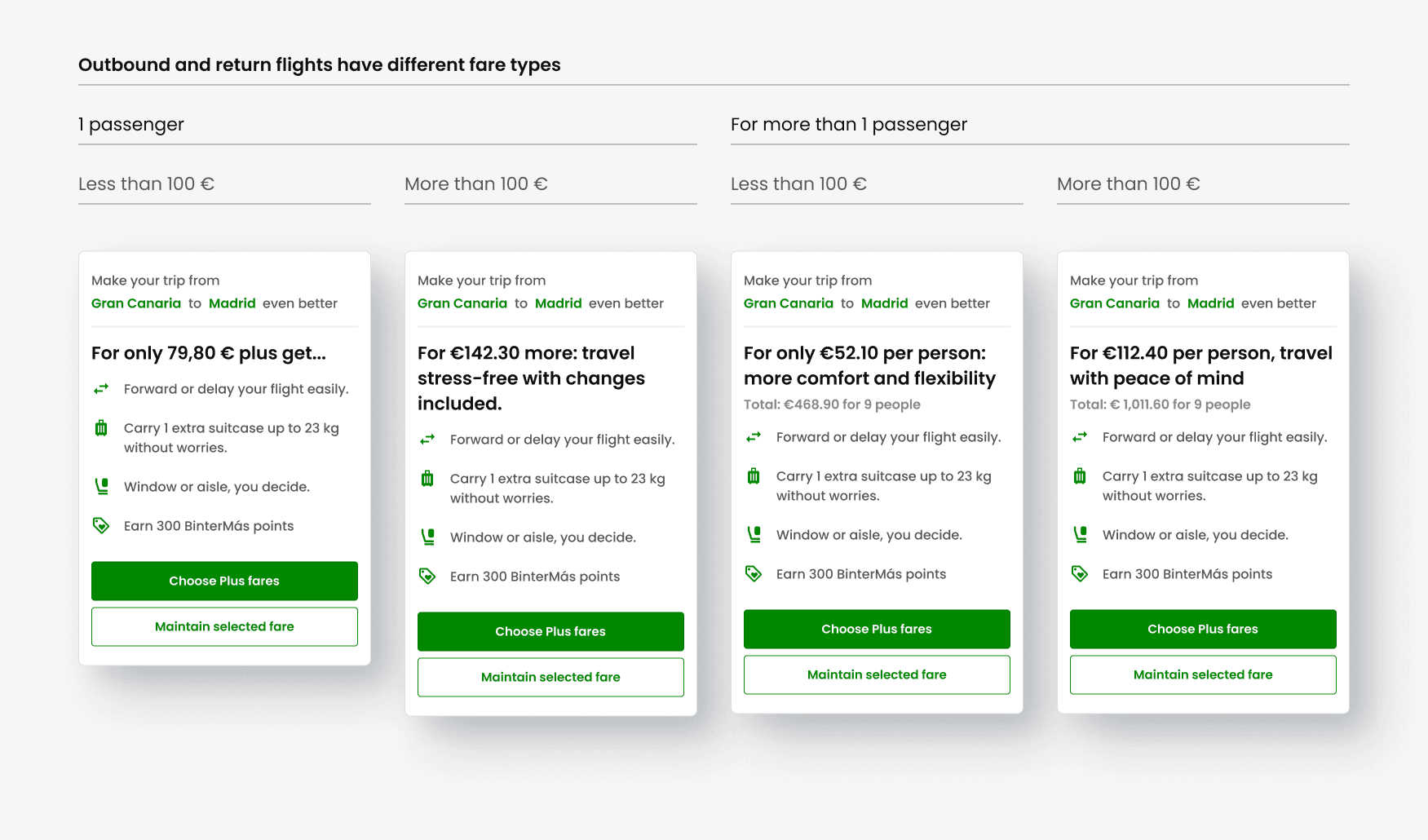
Upsell messaging variations when outbound and return flights have different fare types.
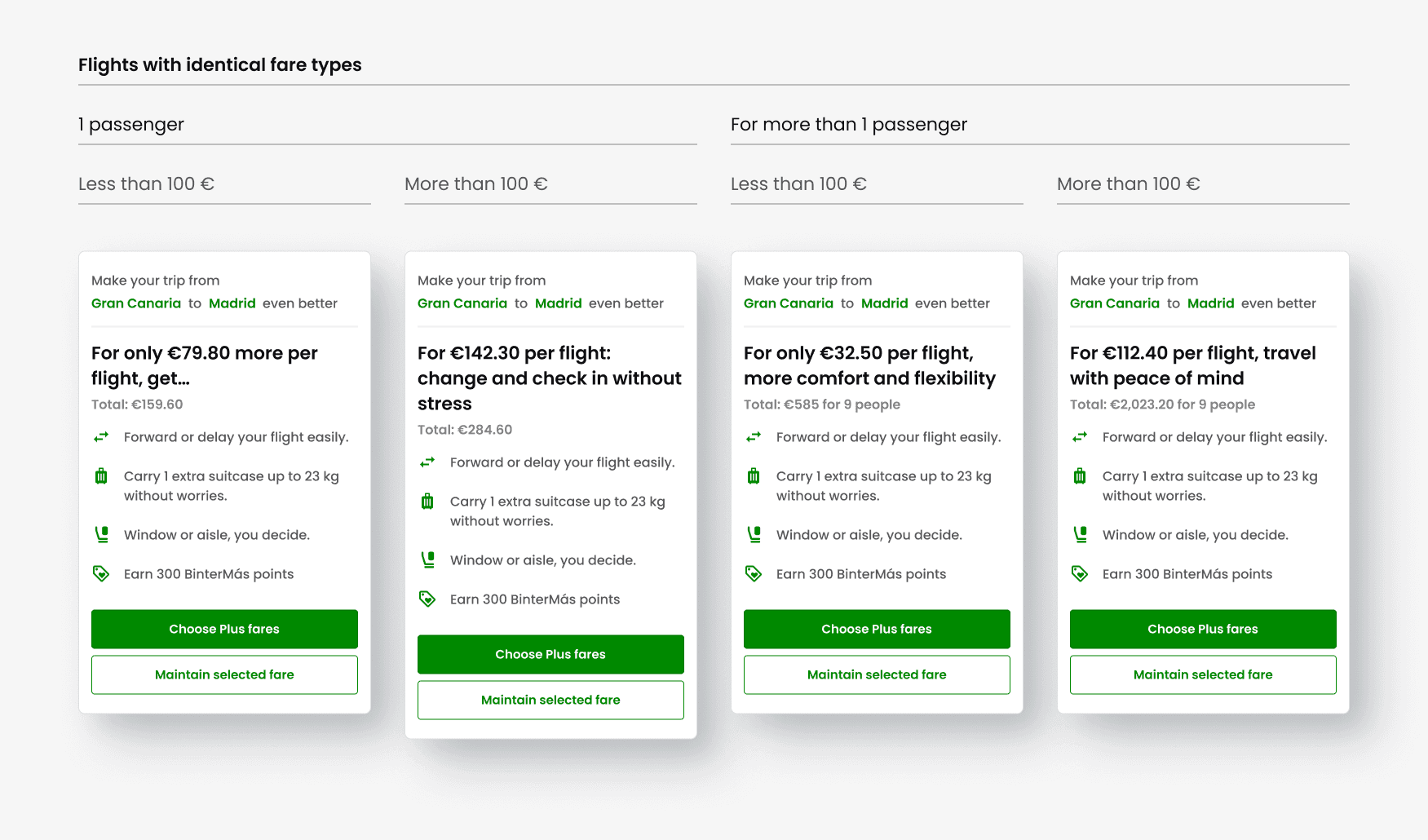
Upsell messaging variations when flights have identical fare types.
Results & Metrics
The new upselling design delivered measurable impact across the board:
Between April 11 and May 30, 2025, we tracked user engagement with the upselling banner on both app and desktop platforms.
Visibility & Interaction Rates
One of our main objectives was to increase the visibility of fare upgrade options (upselling) in the booking flow. The design changes aimed to highlight these options at the right moment without overwhelming the user.
App (mobile)
Total impressions (outbound):
204,742
Users who engaged with upselling:
12,55 %
Total impressions (return):
154,496
Users who engaged with upselling:
12,92 %
Desktop (web)
Total impressions (outbound):
347,330
Users who engaged with upselling:
7.45 %
Total impressions (return):
256,670
Users who engaged with upselling:
7.77%
Average interaction rate
App (Mobile)
12.71%
Desktop
7.59%
These numbers confirm that the mobile experience is more effective in capturing user attention and encouraging upgrade consideration. The timing and presentation strategy—based on progressive disclosure—allowed us to position upselling as a relevant and value-driven decision rather than a sales distraction.
Conversion to Higher Fares
The redesigned upselling experience not only improved visibility—it also translated into measurable sales impact for both Plus and Flexiplus fares.
Plus Fare
Conversion via Upselling
Tickets sold via upselling
2,780
All Plus ticket sales
13,70 %
Tickets sold via upselling
3,707
All Plus ticket sales
7,53 %
FlexiPlus Fare
Conversion via Upselling
Tickets sold via upselling
386
All FlexiPlus ticket sales
9.80%
Tickets sold via upselling
642
All Plus ticket sales
8,20 %
Revenue share from Upselling
***,*** €
in Plus fare upsells (13.06% of total Plus revenue)
**,*** €
in Flexiplus upsells (8.06% of total Flexiplus revenue)
***,*** €
in Plus fare upsells (7.07% of total Plus revenue)
**,*** €
in Flexiplus upsells (7.29% of total Flexiplus revenue)
The upselling strategy proved significantly more effective on the mobile app, where nearly 1 in 7 Plus tickets were sold through the upgrade flow. On the web, upselling was still effective but less prominent—suggesting that the mobile-first design and emotional copywriting had a stronger impact on conversion behavior.
Route-Specific Impact
On Madrid–Canary Islands routes, Flexiplus increased from 29.8% to 35.99%, largely by cannibalizing Basic in a healthy way.
Upselling accounted for 1.41% of total ticket revenue, and 5.14% for national/international segments.
What I Learned?
This project reinforced several important lessons:
Clarity is a business driver. When users understand value, they upgrade more confidently.
Behaviour-informed design is powerful in decision-heavy experiences.
A strong narrative reduces friction, support costs and user confusion.
Early alignment with revenue, product and engineering avoids rework and accelerates delivery.
Small improvements in structure, language and hierarchy can create major impact.
Let’s connect
Thanks for reading! If you’re hiring, collaborating, or just curious about my work — feel free to drop me a line. I’d love to hear from you.
